

Daily versus weekly overtime
California’s general nonexempt rules cover hours above eight per workday and above forty per workweek. Daily overtime can apply even when total weekly hours are below forty. A 10-hour day at $25 yields $200 regular pay and $75 overtime pay.
When double time applies
For ordinary covered employees, hours above twelve in a workday generally earn twice the regular rate. If all seven days of the defined workweek are worked, the seventh-day premiums also apply.
Avoid counting a premium twice
Daily premium hours are not counted again as regular hours for the weekly premium calculation in the tool. Enter the workweek in the correct order rather than using a random seven-day period.
Check exceptions before making a claim
Industry rules, exemptions, alternative schedules and collective bargaining agreements can change the result. The regular rate may include more than the base hourly wage. Consult DIR or a qualified employment professional for disputes.
Work through a five-day schedule
A worker earning $25 per hour works 10 hours on Monday and Tuesday and eight hours on each of Wednesday, Thursday and Friday. The 44 total hours include four daily overtime hours. Under the general California rule, regular earnings are 40 × $25 = $1,000 and the overtime earnings are 4 × $37.50 = $150, for $1,150 gross. Do not add another four weekly overtime hours to the hours already paid at the required premium.
The same total hours can produce different pay
Suppose a worker earns the same rate and works 14 hours on one day, followed by four six-hour days. Total hours are 38, but daily premiums still matter: 32 regular hours, four time-and-a-half hours and two double-time hours. Gross pay is $800 + $150 + $100 = $1,050. A weekly-only calculation would miss those daily premiums. These examples assume an ordinary nonexempt schedule without special wage-order exceptions.
Why the regular rate matters
The rate used to calculate overtime is not always the hourly base rate displayed on a schedule. Certain nondiscretionary bonuses and other compensation can affect the regular rate. Our tool expects a correctly determined regular rate. If your employer has multiple rates, shift premiums or bonuses, ask payroll how those amounts are included.
Overtime wages versus the federal deduction
Calculating overtime wages and determining eligibility for the federal qualified overtime deduction are separate tasks. The latter may apply only to the qualifying FLSA premium, not every dollar earned at overtime rates under California law. California does not adopt that federal deduction under the cited FTB guidance. See our news update on qualified overtime for more information.
Example at $25 per hour
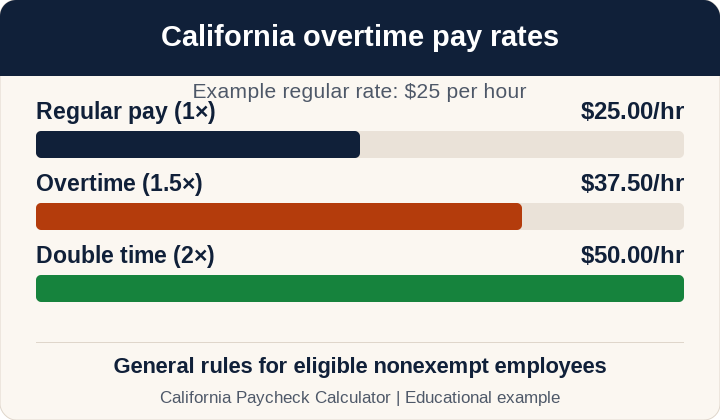
| Pay category | Rate per hour |
|---|---|
| Regular | $25.00 |
| Time and a half | $37.50 |
| Double time | $50.00 |
Related calculator example
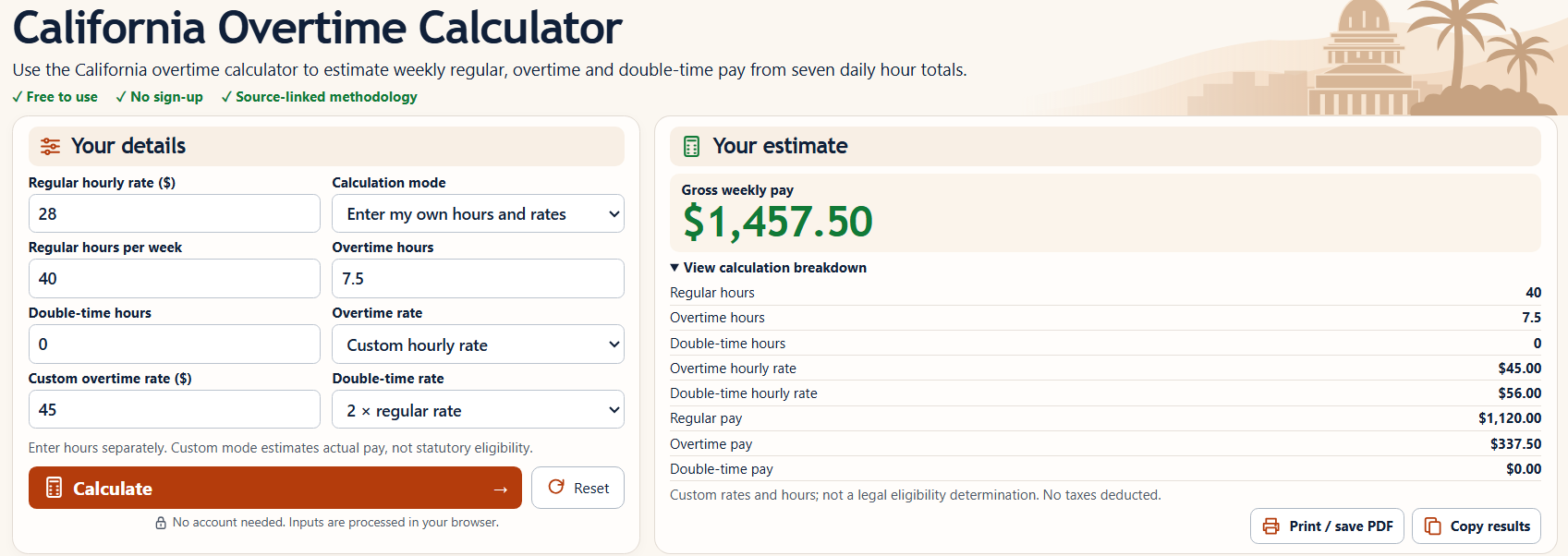
Actual calculator screens using hypothetical inputs. These examples are illustrative estimates, not personal financial advice.
Custom overtime rate example
Frequently asked questions
Can I earn overtime without working 40 hours?
Under the general California daily overtime rule, yes. Certain alternative schedules and exemptions can change the result.
Does this estimate include tax withholding?
No. The overtime calculator estimates gross wages. The paycheck calculator estimates taxes separately.
Calculate your own estimate
Try the California Overtime Calculator using your own figures.
Official sources and methodology
Rules reviewed 2026-11-25. Consult the source agencies for the latest guidance and individual exceptions.
Educational content, not individual tax or legal advice. Source review: 2026-11-25.