
How is California overtime pay calculated?
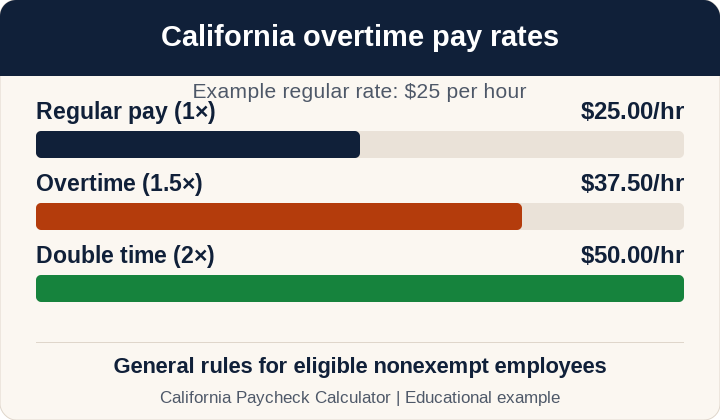
For the general nonexempt rule, multiply eligible overtime hours by 1.5 times the regular hourly rate and eligible double-time hours by 2 times that rate. Daily, weekly and seventh-day rules can apply. At $25 per hour, the corresponding hourly amounts are $37.50 and $50.00.
How to use the California Overtime Calculator
Enter your regular hourly rate and the hours worked each day of the defined workweek. The estimate separates regular, time-and-a-half and double-time earnings.
How California overtime works
For a typical nonexempt employee under the general rule, hours beyond eight in a workday or forty in a workweek qualify for time and a half. Hours beyond twelve in a day qualify for double time. When all seven days of the defined workweek are worked, the first eight hours on the seventh day generally qualify for time and a half and later hours for double time.
Calculate overtime with custom rates
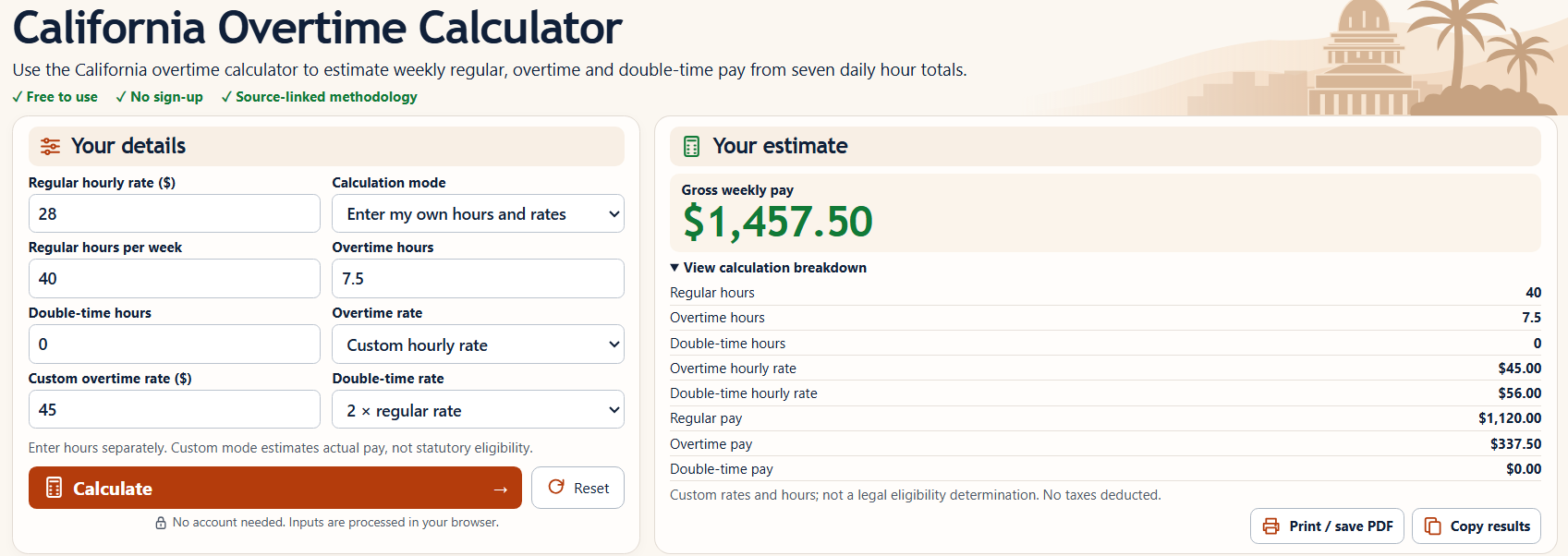
Choose California standard rules to classify daily and weekly hours. If you already know your regular, overtime and double-time hours, choose Enter my own hours and rates. Set a multiplier or the full hourly rate for each premium category. For example, 40 regular hours at $28 plus 7.5 overtime hours at $45 yields $1,457.50 weekly gross. A custom rate is an estimate of pay, not confirmation of compliance with wage law.
Enter your actual workweek
Enter the regular rate of pay and hours for each day in your employer’s defined workweek, starting with its first day. The calculation first assigns daily premiums and then applies weekly overtime to remaining straight-time hours beyond forty, avoiding double counting.
Worked example: a separate overtime-paying schedule
At $20 per hour, five 10-hour workdays produce 40 regular hours and 10 overtime hours. Gross weekly earnings are $800 plus $300 overtime, or $1,100. Five 13-hour days would also include double-time hours.
When this tool does not apply
Alternative workweek schedules, exemptions, collective agreements and occupation-specific rules may change the answer. The regular rate can include commissions and nondiscretionary bonuses; an hourly base rate alone may be insufficient. Use the official DIR guidance for these cases. This is gross pay, not take-home pay.
Standard mode when no overtime is due
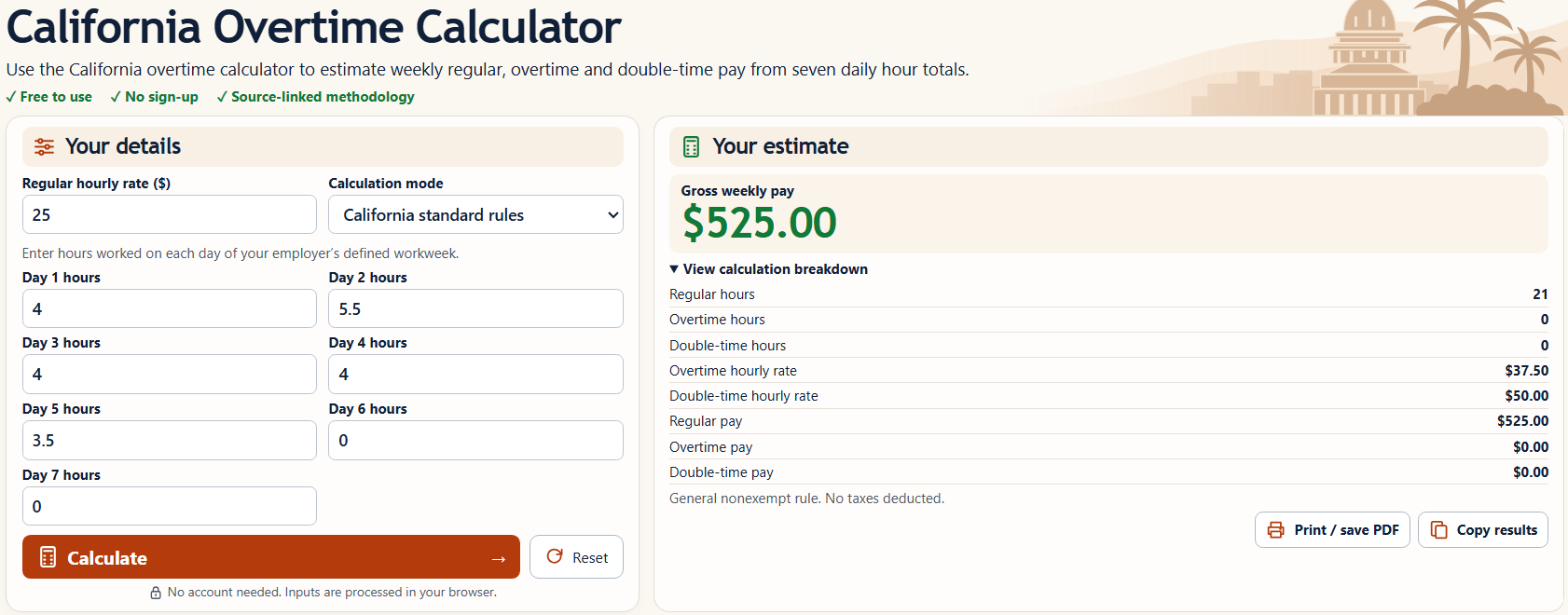
The standard-mode screenshot shows 21 hours at $25 per hour, with no day above eight hours and no weekly overtime. The gross result is $525. The separate five-day, 50-hour example above demonstrates how eligible overtime is calculated.
Calculator screenshots and worked examples
Actual calculator screens using hypothetical inputs. These examples are illustrative estimates, not personal financial advice.
Standard overtime mode: no qualifying overtime
Custom overtime rate example
Frequently asked questions
Do California employees get double time?
Under the general nonexempt rule, yes for hours above 12 in a workday and hours above eight on the seventh consecutive day of the workweek.
Can the same hour earn two overtime premiums?
The calculator does not stack daily and weekly premiums on the same hour.
What if my company pays more than time and a half?
Choose custom mode and enter the actual hourly rate or a higher multiplier. The tool flags rates below the general minimum multiplier when the regular rate is known.
Official sources and methodology
Rules reviewed 2026-11-25. Consult the source agencies for the latest guidance and individual exceptions.
Source review: 2026-11-25. Automated tests are not an independent payroll audit. Editorial policy.