

What the August update means
On August 6, 2026, the IRS issued updated questions and answers on the federal deduction for qualified overtime compensation. This is relevant to California workers because state overtime rules can be broader than federal rules. The deduction relates to eligible federal overtime premiums for the applicable tax years, not a blanket exemption for overtime wages.
Separate base earnings from the premium
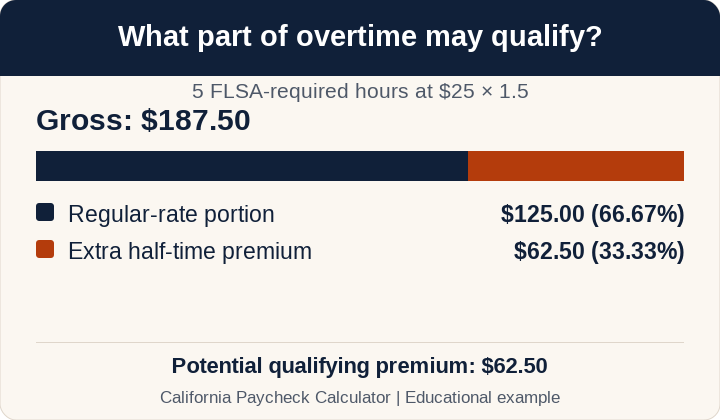
Imagine an eligible employee earns $25 an hour and works 45 hours in an ordinary federal workweek. The five overtime hours are paid at $37.50, producing $187.50 of overtime earnings. Only the additional $12.50 per hour above the regular rate, or $62.50 in this example, is the potentially qualifying federal premium. The remaining $125 is ordinary compensation for those hours. Eligibility and annual limits still apply.
Daily California overtime is not necessarily federal overtime
An employee who works 10 hours one day and a total of only 38 hours that week may receive California overtime even though the ordinary federal weekly overtime threshold was not exceeded. Do not automatically count that state-only premium as qualified federal overtime. The nature of the hours and the federal coverage rules determine eligibility.
California tax and payroll tax are separate
The California FTB’s published conformity summary says the state does not conform to the federal overtime deduction. Ordinary Social Security and Medicare taxes also continue to apply to overtime wages. An eligible federal deduction may reduce federal taxable income but should not be used to remove those other deductions from a paycheck calculation.
How to use our tools responsibly
Use the overtime calculator to estimate gross regular, overtime and double-time earnings. It does not determine the deductible portion for a tax return. Retain employer records, check the reported qualified premium and use official tax form instructions or professional guidance for individual eligibility. Avoid treating the entire overtime gross amount as tax-free in your budget.
Illustrative five hours of federally required overtime
| Component | Amount |
|---|---|
| Base compensation for five hours | $125.00 |
| Extra half-time premium | $62.50 |
| Gross overtime earnings | $187.50 |
| Potential qualifying premium before limits | $62.50 |
Frequently asked questions
What are the federal deduction limits?
The IRS describes limits of $12,500 or $25,000 for a joint return, with reductions at higher modified adjusted gross incomes and other eligibility rules.
Does California allow the same deduction?
The cited FTB conformity summary says California does not conform to this deduction. Check for later legislative changes.
Calculate your own estimate
Try the California Overtime Calculator using your own figures.
Official sources and methodology
Rules reviewed 2026-11-25. Consult the source agencies for the latest guidance and individual exceptions.
Educational content, not individual tax or legal advice. Source review: 2026-11-25.