

Start with gross earnings
Check the pay period, hourly rate or salary and paid hours. Gross earnings can include overtime, bonuses and other compensation. A salary of $78,000 paid over 26 checks starts at $3,000 gross per check.
Identify withholding lines
Federal income tax, state personal income tax, Social Security and Medicare are usually separate lines. California SDI is an additional covered-wage contribution. Compare the pay stub’s taxable wage amounts rather than assuming every tax uses the same gross number.
Review benefit deductions
Traditional retirement contributions can reduce income-tax wages but generally do not reduce Social Security and Medicare wages. Other benefits can have different tax treatment. After-tax deductions reduce take-home pay without reducing taxable wages.
Reconcile the amount deposited
Gross earnings minus withheld amounts and other deductions should match net pay. If a stub has year-to-date columns, those numbers are useful for understanding the Social Security cap and Additional Medicare threshold. Use the main calculator with matching inputs; payroll can explain any differences.
Find the pay period before comparing amounts
The pay period shows which days the earnings cover, while the payment date is when the check is issued. A paycheck that includes a holiday, unpaid leave or a partial first week may look different from a normal check. Compare periods of the same length before assuming that a change in take-home pay reflects a new tax rate.
For hourly work, multiply regular hours by the applicable rate, then account for overtime or other earnings separately. Salaried employees can start with annual pay divided by the number of scheduled checks.
A practical paycheck reconciliation
Imagine a check with gross wages of $2,000, federal withholding of $180, state withholding of $65, Social Security of $124, Medicare of $29 and SDI of $26. If retirement contributions and other deductions total $100, the resulting deposit is $1,476. These are illustrative amounts, not an income tax calculation. The reconciliation works because all the amounts refer to the same check.
If the employer splits deposits between two accounts, add both deposits before comparing the total to net pay. Reimbursements may also appear separately from wages.
What year-to-date amounts tell you
Year-to-date amounts summarize earnings and deductions since the beginning of the applicable payroll year. A year-to-date tax figure is not the deduction for this particular check. When testing a calculator, use prior wages rather than a cumulative figure that already includes the check you are calculating. Social Security can stop being withheld once the applicable wage base is reached; Medicare and SDI behave differently.
If something seems wrong
Keep a copy of the relevant earnings statement and compare the wage rate, hours, current deductions and year-to-date figures with your records. Ask payroll to explain an unexpected item before assuming it is an error. Our calculator can help isolate the difference, but it cannot read your employer’s elections or benefit plan. Never submit a real pay stub or Social Security number through our feedback form.
Illustrative paycheck reconciliation
| Paycheck item | Amount |
|---|---|
| Gross earnings | $2,000.00 |
| Income tax withholding | $245.00 |
| Social Security and Medicare | $153.00 |
| California SDI | $26.00 |
| Other deductions | $100.00 |
| Net deposit | $1,476.00 |
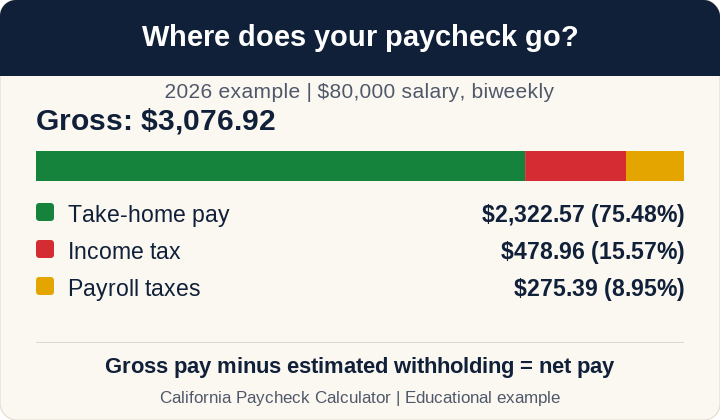
Related calculator example
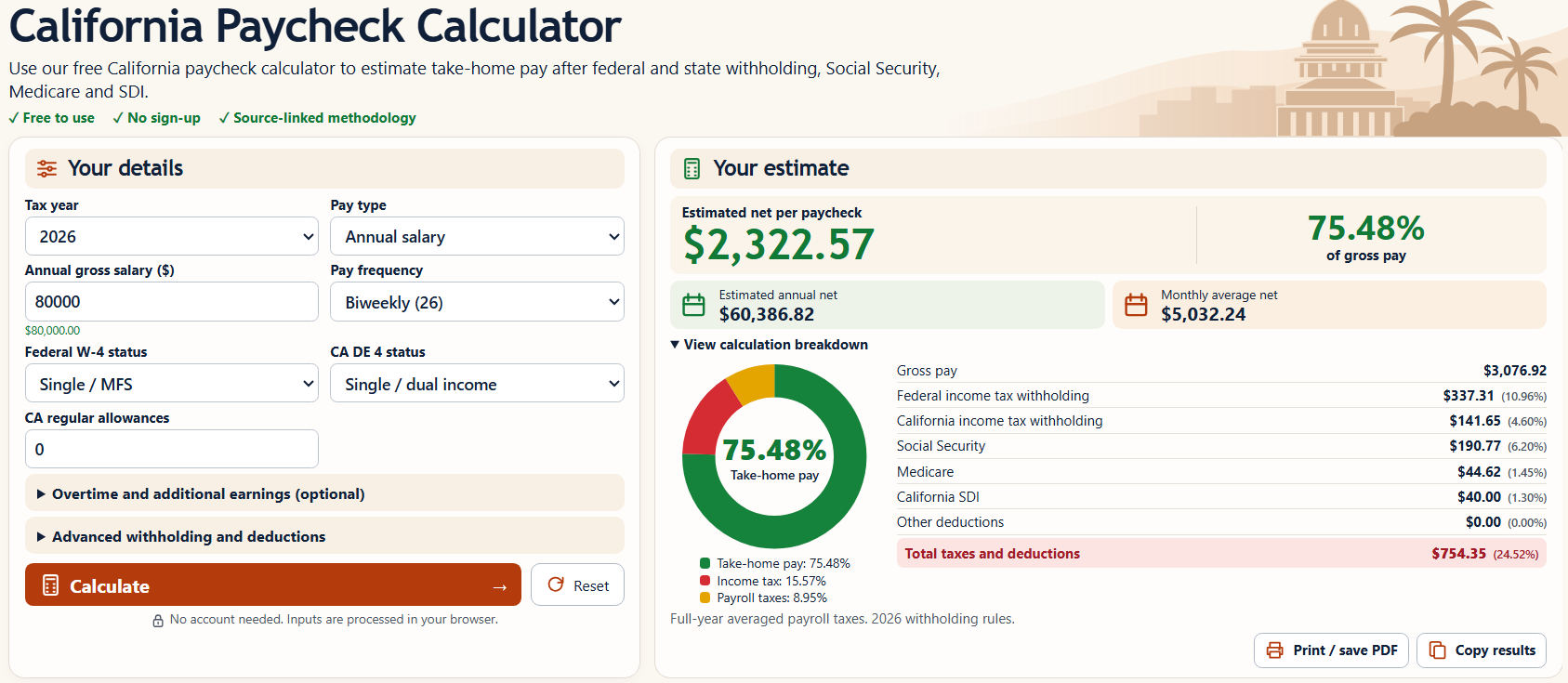
Actual calculator screens using hypothetical inputs. These examples are illustrative estimates, not personal financial advice.
2026 paycheck on an $80,000 salary
Frequently asked questions
Is gross pay the same as taxable wages?
Not always. Some deductions or benefits can change the wage base for a particular tax.
What if the calculator differs from my check?
Compare the pay period, W-4, DE 4 and taxable wage bases first. Rounding and employer-specific benefits can also cause differences.
Calculate your own estimate
Try the California Paycheck Calculator using your own figures.
Official sources and methodology
Rules reviewed 2026-11-25. Consult the source agencies for the latest guidance and individual exceptions.
Educational content, not individual tax or legal advice. Source review: 2026-11-25.