
Biweekly means every two weeks
A typical calendar year contains 26 biweekly pay dates. Some calendars contain 27; confirm your employer’s schedule before treating an annual estimate as exact.
Semimonthly means twice a month
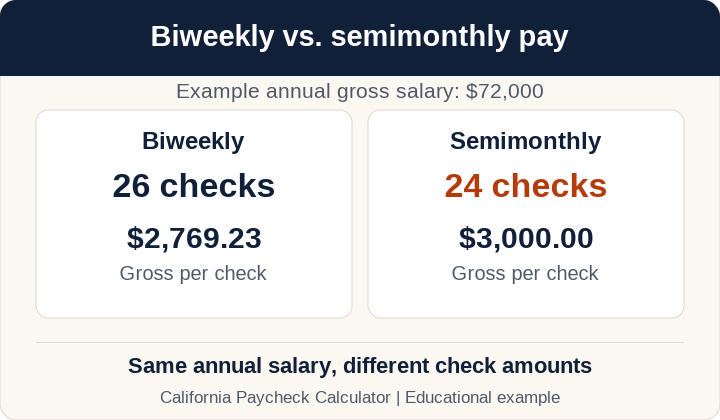
Semimonthly pay produces 24 checks in a standard year. At $72,000 per year, gross semimonthly pay is $3,000 compared with about $2,769.23 for 26 biweekly checks.
Why net pay changes
A different pay frequency changes the amount of each withholding payment, and benefits may be deducted on a different schedule. Use the main calculator with your actual frequency.
Budgeting with different schedules
Biweekly workers may have two months with three checks in a typical year. For budgeting, distinguish the usual two-check month from the annual monthly average.
Compare the same annual salary
On an $80,000 salary, dividing by 26 gives about $3,076.92 per biweekly paycheck. Dividing by 24 gives about $3,333.33 semimonthly. The larger semimonthly check does not mean the employer pays a higher annual salary. Minor differences in rounded paycheck amounts can be reconciled by payroll.
Build a monthly budget without assuming every month is identical
Biweekly workers often receive two checks in a month and occasionally three, depending on the payroll calendar. Budgeting regular bills using two checks can make cash flow easier to understand. The annual average divided by 12 is useful for planning, but it may not equal the cash deposited in a particular month. Semimonthly schedules usually have two payments per month even though the number of days between checks varies.
When 27 biweekly pay dates occur
Depending on the calendar and payday alignment, a particular year can contain 27 biweekly pay dates. Employers may handle salaried pay differently in these years, so check the actual payroll calendar. Our standard biweekly option uses 26 periods and does not model employer-specific 27-period adjustments.
Benefit deductions can follow a different schedule
Some employers deduct benefits from every check, while others spread them across a different number of checks. Comparing two pay frequencies with identical per-check benefit inputs can change annual deductions unintentionally. Convert the benefit amount to the same annual basis first, then enter the actual deduction for the new frequency.
Gross salary by pay schedule
| Frequency | Checks/year | Gross/check |
|---|---|---|
| Weekly | 52 | $1,538.46 |
| Biweekly | 26 | $3,076.92 |
| Semimonthly | 24 | $3,333.33 |
| Monthly | 12 | $6,666.67 |
Related calculator example
Actual calculator screens using hypothetical inputs. These examples are illustrative estimates, not personal financial advice.
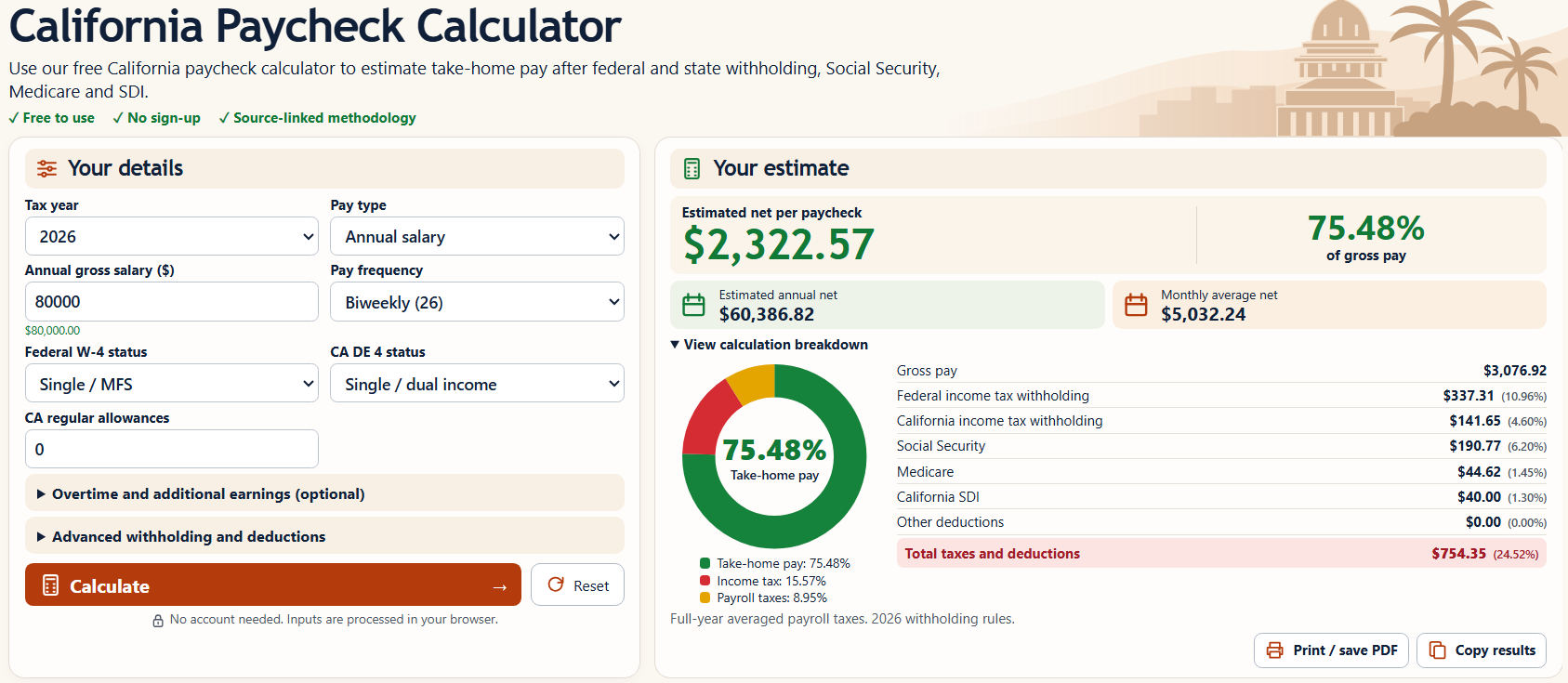
2026 paycheck on an $80,000 salary
Frequently asked questions
Is biweekly the same as twice a month?
No. Biweekly is every two weeks; semimonthly is twice each month.
Which schedule results in more yearly earnings?
Neither by itself. The annual salary and employer payroll rules determine the amount.
Calculate your own estimate
Try the California Paycheck Calculator using your own figures.
Official sources and methodology
Rules reviewed 2026-11-25. Consult the source agencies for the latest guidance and individual exceptions.
Educational content, not individual tax or legal advice. Source review: 2026-11-25.