

Gross pay is before deductions
Gross pay includes ordinary salary or hourly earnings and may include premium pay or bonuses. Net pay is the amount after employee taxes and other deductions.
A basic reconciliation
If gross pay is $3,000 and total deductions are $700, the deposit is $2,300. The net share is $2,300 divided by $3,000, or about 76.7%. This is a hypothetical example, not a California tax calculation.
Use the correct tax bases
Federal and California withholding can use different taxable wages from Social Security or Medicare. Traditional retirement deferrals are one example. Check the details in your pay stub before comparing.
Gross pay, taxable pay and deposited pay
Three numbers may appear on the same statement. Gross pay is earned compensation before deductions; taxable wages are the amount subject to a particular tax; net pay is the remaining deposit. A traditional 401(k) contribution may reduce federal income tax withholding wages without reducing ordinary Social Security or Medicare wages. A benefit may have different treatment for California tax purposes.
Compare two offers on a consistent basis
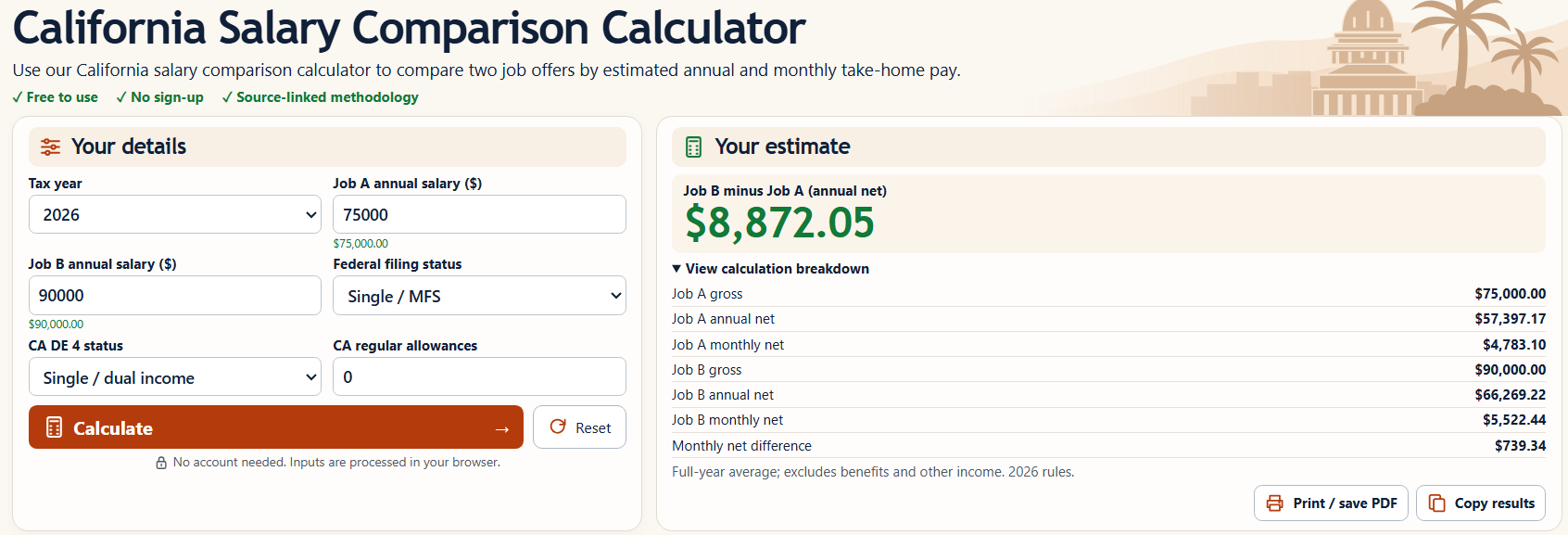
Imagine two jobs offering $75,000 and $80,000 annually. The difference in gross pay is $5,000, or about $416.67 per month before deductions. The difference in net pay is smaller in a typical taxable scenario. Use identical filing elections and pay frequencies for the comparison, then account separately for the cost of health coverage, retirement match and commuting. A higher gross salary may come with higher costs.
Turn your annual budget into a paycheck target
If you need $3,000 per month for recurring expenses, a 26-period payroll schedule requires approximately $1,384.62 per check on an annual-average basis. That is a net target, not a gross salary. To see what gross earnings might support it, test several salary amounts in the calculator and compare the monthly average. Real monthly cash flow depends on the actual payday calendar.
Check unusual deductions separately
Court-ordered deductions, benefit premiums, union dues and employer-specific programs may not be represented in a simplified estimate. Use the available after-tax field only for actual after-tax deductions; do not treat a pre-tax benefit as after-tax simply to force a match. Ask payroll how a deduction is classified.
A hypothetical gross-to-net calculation
| Item | Monthly amount |
|---|---|
| Gross earnings | $4,000 |
| Taxes and payroll contributions | $750 |
| Other deductions | $250 |
| Net pay | $3,000 |
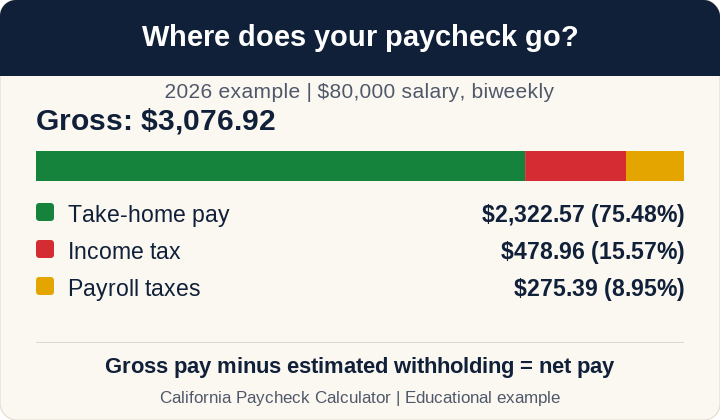
Related calculator example
Actual calculator screens using hypothetical inputs. These examples are illustrative estimates, not personal financial advice.
2026 comparison of $75,000 and $90,000 salaries
Frequently asked questions
Is take-home pay the same as salary?
No. Take-home pay is what remains after deductions; advertised salary typically refers to gross pay.
Can I use this to calculate final income tax?
The paycheck tool estimates withholding, not the final tax return.
Calculate your own estimate
Try the California Paycheck Calculator using your own figures.
Official sources and methodology
Rules reviewed 2026-11-25. Consult the source agencies for the latest guidance and individual exceptions.
Educational content, not individual tax or legal advice. Source review: 2026-11-25.