

The new employee limit
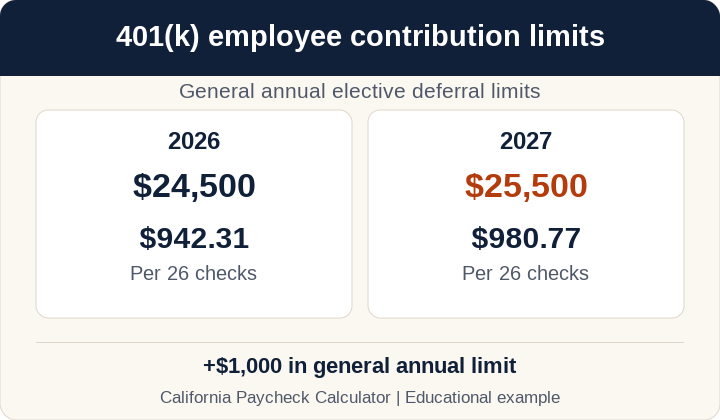
The IRS announced a 2027 employee elective deferral limit of $25,500 for ordinary 401(k) plans, compared with $24,500 in 2026. This is the general limit before eligible catch-up contributions. The announcement also covers several other retirement plan types; not every plan follows the same limit or permits the same contributions.
Translate the increase into paycheck amounts
The additional $1,000 of annual contribution capacity is approximately $38.46 each biweekly pay period, $41.67 semimonthly, or $83.33 monthly. These values describe the extra contribution, not necessarily the reduction in net pay. An employee who does not contribute up to the old limit may not need to change anything.
Traditional versus Roth contributions
Traditional elective deferrals generally reduce current federal income tax withholding wages but remain subject to ordinary Social Security and Medicare taxes. Roth contributions generally use after-tax dollars. A contribution increase can therefore affect the cash deposited differently depending on the type of contribution and other tax rules. Our paycheck calculator has a field for actual traditional 401(k) amounts per check and an after-tax deduction field; it does not decide which type is right for you.
Catch-up contributions
The general 2027 catch-up limit for eligible workers age 50 and over in most of the relevant plans is $8,500, up from $8,000. The special limit for eligible participants aged 60 through 63 is $11,750. Plan eligibility, income-related Roth requirements and other rules can affect what is allowed. Check the plan documents and current IRS instructions before changing elections.
A practical year-end check
Find the number of planned paychecks for 2027 and review your actual contribution election, including whether it is a percentage or a fixed amount. Consider employer matching arrangements and plan-specific restrictions before spreading contributions across pay periods. The new federal limit is not a recommended savings target and does not guarantee that your employer will match the full amount.
General elective deferral limit divided by pay periods
| Frequency | 2026 | 2027 |
|---|---|---|
| Annual | $24,500 | $25,500 |
| Biweekly (26) | $942.31 | $980.77 |
| Semimonthly (24) | $1,020.83 | $1,062.50 |
| Monthly (12) | $2,041.67 | $2,125.00 |
Frequently asked questions
Does the calculator enforce the 401(k) annual contribution limit?
No. Enter the actual permitted contribution per check; plan limits and eligibility require separate review.
Will a $100 traditional contribution reduce net pay by exactly $100?
Not necessarily. Changes in income tax withholding can offset some of the contribution.
Calculate your own estimate
Try the California Paycheck Calculator using your own figures.
Official sources and methodology
Rules reviewed 2026-11-25. Consult the source agencies for the latest guidance and individual exceptions.
Educational content, not individual tax or legal advice. Source review: 2026-11-25.