
What changed?
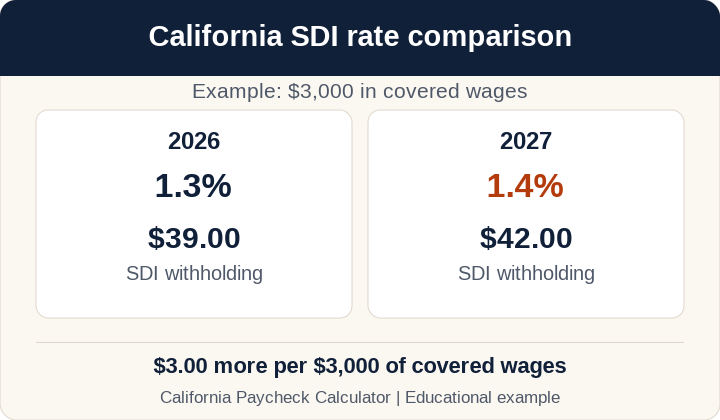
The California EDD published a 1.4% employee State Disability Insurance withholding rate for 2027, compared with 1.3% in 2026. The increase applies to covered wages, without an annual wage ceiling.
What it means for your paycheck
On $3,000 of covered wages, withholding increases from $39 to $42. On $80,000 of annual covered wages, it increases from $1,040 to $1,120. This $80 difference is only the SDI contribution, not the total change in take-home pay.
Check the correct wage base
Your gross wages may not match SDI-covered wages. Employees with a voluntary plan or exempt employment can have different deductions. Compare your pay stub with the official guidance.
Estimate the effect at different salary levels
The increase is one tenth of one percentage point. Multiplying covered annual wages by 0.001 gives the additional yearly contribution. A worker with $50,000 in covered wages would contribute $50 more per year; a worker with $150,000 in covered wages would contribute $150 more. For an $80,000 annual wage over 26 checks, the difference averages about $3.08 per check. These comparisons hold wages constant and isolate SDI.
Why you should not compare two whole paychecks using only SDI
Other withholding tables and wages can change at the same time. A January check may also reflect Social Security restarting after the previous wage limit was reached. The SDI difference is one piece of the net-pay change, not a prediction of the total change. The published rate is available in our SDI calculator even while full 2027 withholding calculations remain pending.
What to look for on a California pay stub
An employee may see a line such as SDI or CASDI. Start with the covered taxable wage amount for that line and compare the period and rate. If the line is absent or uses a different amount, ask payroll whether a voluntary plan, exemption or other wage-base rule applies. Do not assume every California worker has the same coverage.
Prepare your own estimate
Select 2026 and enter a typical covered paycheck in the SDI calculator. Record the result, then select 2027 with the same wages and frequency. This comparison avoids confusing a raise or changed hours with the effect of the rate itself.
SDI increase by covered annual wages
| Annual wages | 2026 SDI | 2027 SDI | Increase |
|---|---|---|---|
| $50,000.00 | $650.00 | $700.00 | $50.00 |
| $80,000.00 | $1,040.00 | $1,120.00 | $80.00 |
| $100,000.00 | $1,300.00 | $1,400.00 | $100.00 |
| $150,000.00 | $1,950.00 | $2,100.00 | $150.00 |
| $200,000.00 | $2,600.00 | $2,800.00 | $200.00 |
Related calculator example
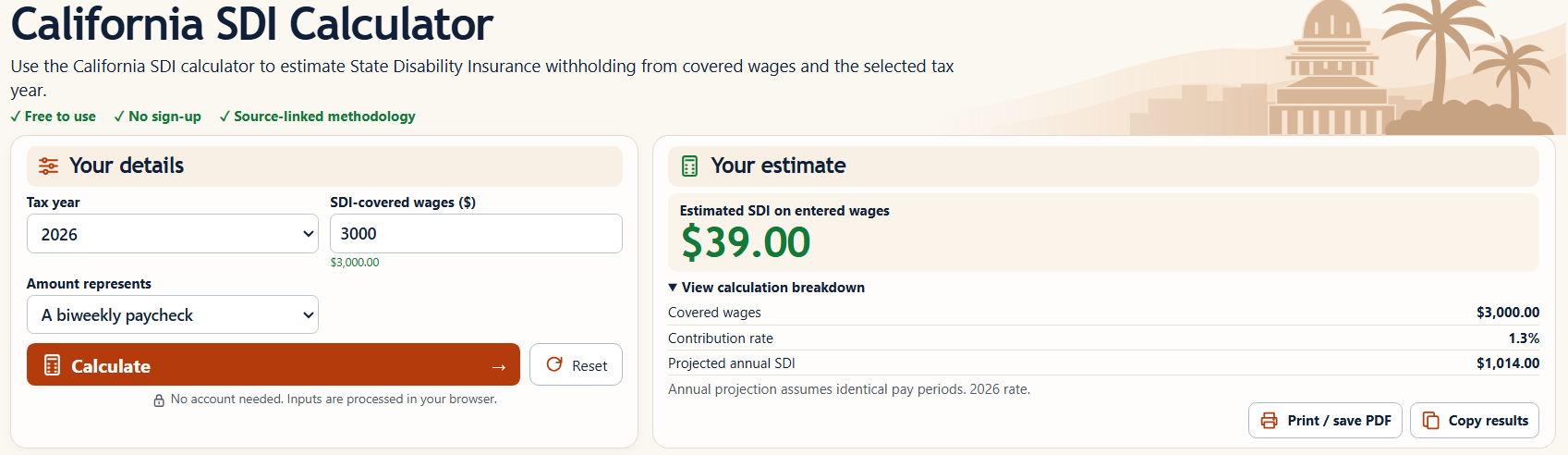
Actual calculator screens using hypothetical inputs. These examples are illustrative estimates, not personal financial advice.
2026 SDI withholding on $3,000
Frequently asked questions
Is 1.4% already effective in November 2026?
No. It is the published 2027 rate, effective for the new year.
Does this change increase my final income tax?
It changes the SDI contribution; it is not an income tax bracket change.
Calculate your own estimate
Try the California SDI Calculator using your own figures.
Official sources and methodology
Rules reviewed 2026-11-25. Consult the source agencies for the latest guidance and individual exceptions.
Educational content, not individual tax or legal advice. Source review: 2026-11-25.